
Diagram illustrating a high-throughput background pipeline using System.Threading.Channels in ASP.NET Core

C# Channels - Why so forgotten? Designing High-Throughput Background Pipelines

Designing high-throughput background pipelines with C# System.Threading.Channels When our project receives thousands of requests per minute, we need to take some cares. Usually, the bottleneck isn’t CPU. Probabily the problem is one (or more) of these: I/O contention, thread starvation, uncontrolled concurrency, excessive allocations… et cetera. One of the most common mistakes in high-throughput (even in medium-throughput) APIs is coupling request processing with expensive secondary operations such as: audit logging; telemetry; webhook dispatching; email sending; analytics; event persistence. So it causes response times increasing, thread pressure growing and throughput collapses. ...
May 13, 2026 · 7 min · 1280 words · Eduardo Potumati
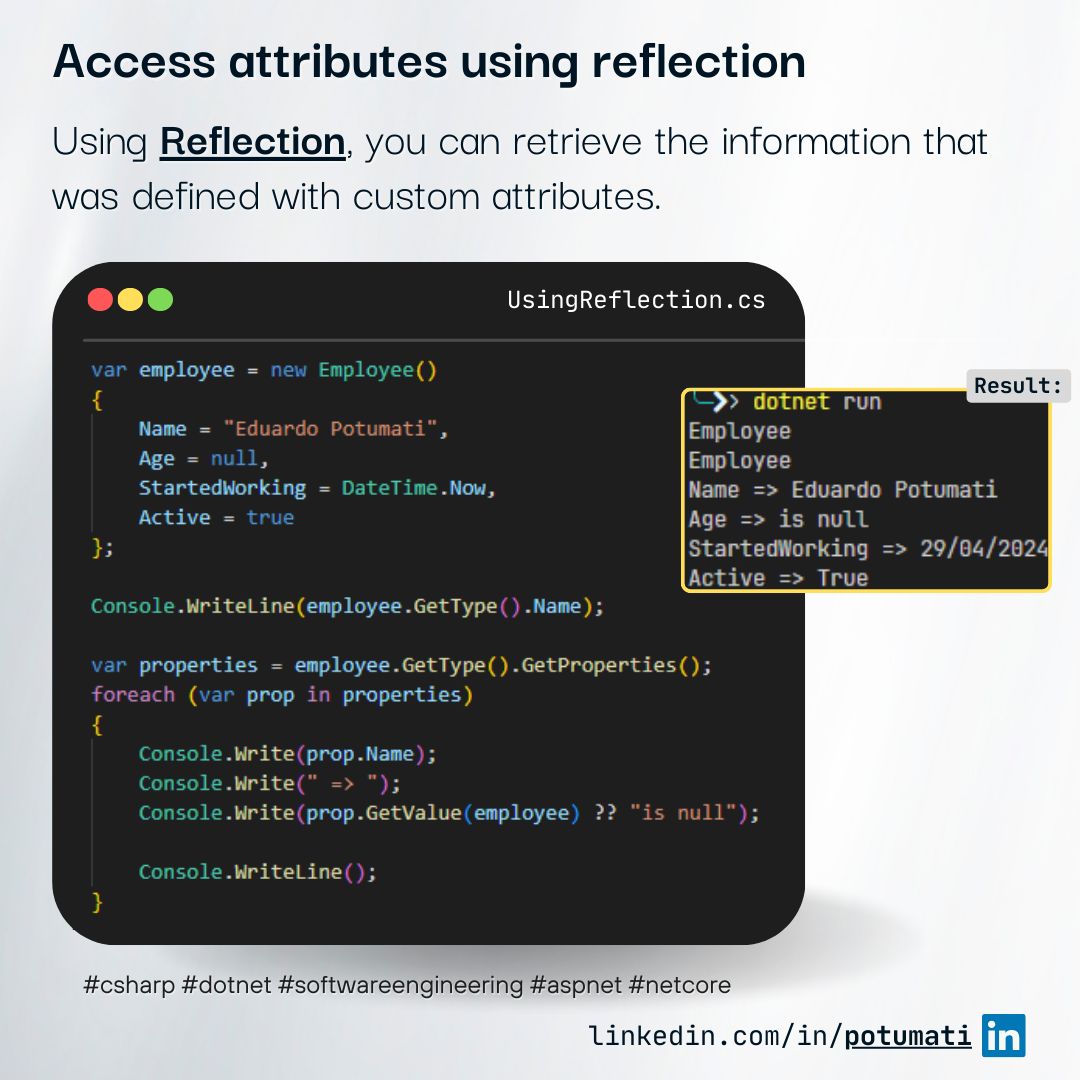
Code snippet demonstrating how to use Reflection to read custom attributes in C#

Accessing Custom Attributes Using Reflection in C#

Accessing Custom Attributes Using Reflection in C# Custom attributes provide a powerful way to attach declarative metadata to your code-whether it’s on classes, methods, properties, or fields. But how do you actually read that metadata at runtime? This is where Reflection shines. By using the System.Reflection, you can dynamically inspect your code’s structure and retrieve the information defined within those custom attributes. This functionality is the backbone for creating highly flexible applications, such as automated validation frameworks, custom JSON serializers, or dynamic API routing systems. ...

June 15, 2024 · 1 min · 116 words · Eduardo Potumati