
I recently published a detailed technical article on Balta.io-one of the premier .NET ecosystem references in Brazil-addressing a critical topic for high-performance systems: concurrency control.
As software engineers with extensive experience in high-demand solutions, we often face the challenge of “doing as much as possible, as fast as possible”. However, infrastructure realities-such as rate limits in third-party APIs or hardware constraints-force us to understand exactly when and how to throttle our execution.
Why read this article?
In modern system development-particularly in Streaming scenarios and massive data processing where I have spent over 20 years of my career-the naive use of Task.WhenAll can lead to resource exhaustion or being blocked by external services.
In this guide, I explore:
- SemaphoreSlim: The ideal choice for modern applications, optimized for
async/awaitwith low memory overhead. - Semaphore (Legacy/Global): When you truly need to step outside your application’s scope and control concurrency at the Operating System level (cross-process).
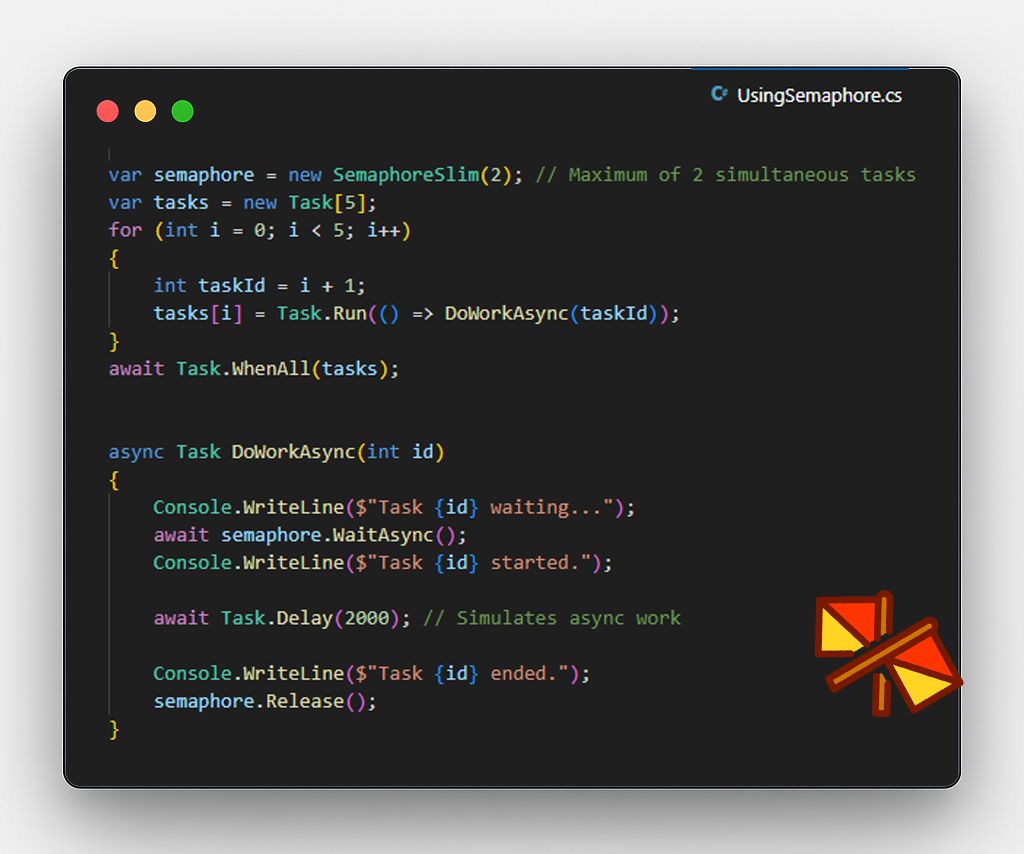
Technical Highlight: The “Real-World” Scenario
In the article, I use a practical analogy derived from common architectural challenges: controlling requests to a weather API and orchestrating heavy video transcoding processes.
Key Takeaway: While
SemaphoreSlimacts as an efficient traffic guard within your code, the classicSemaphoreis capable of coordinating traffic between different “cities” (processes) on your server.
Read the full article on Balta.io
To check out the complete code examples, try/finally implementations with Release(), and the nuances between named and local semaphores, access the original link (in Portuguese):
👉 Concurrency Control in C#: Semaphore and SemaphoreSlim - Balta.io