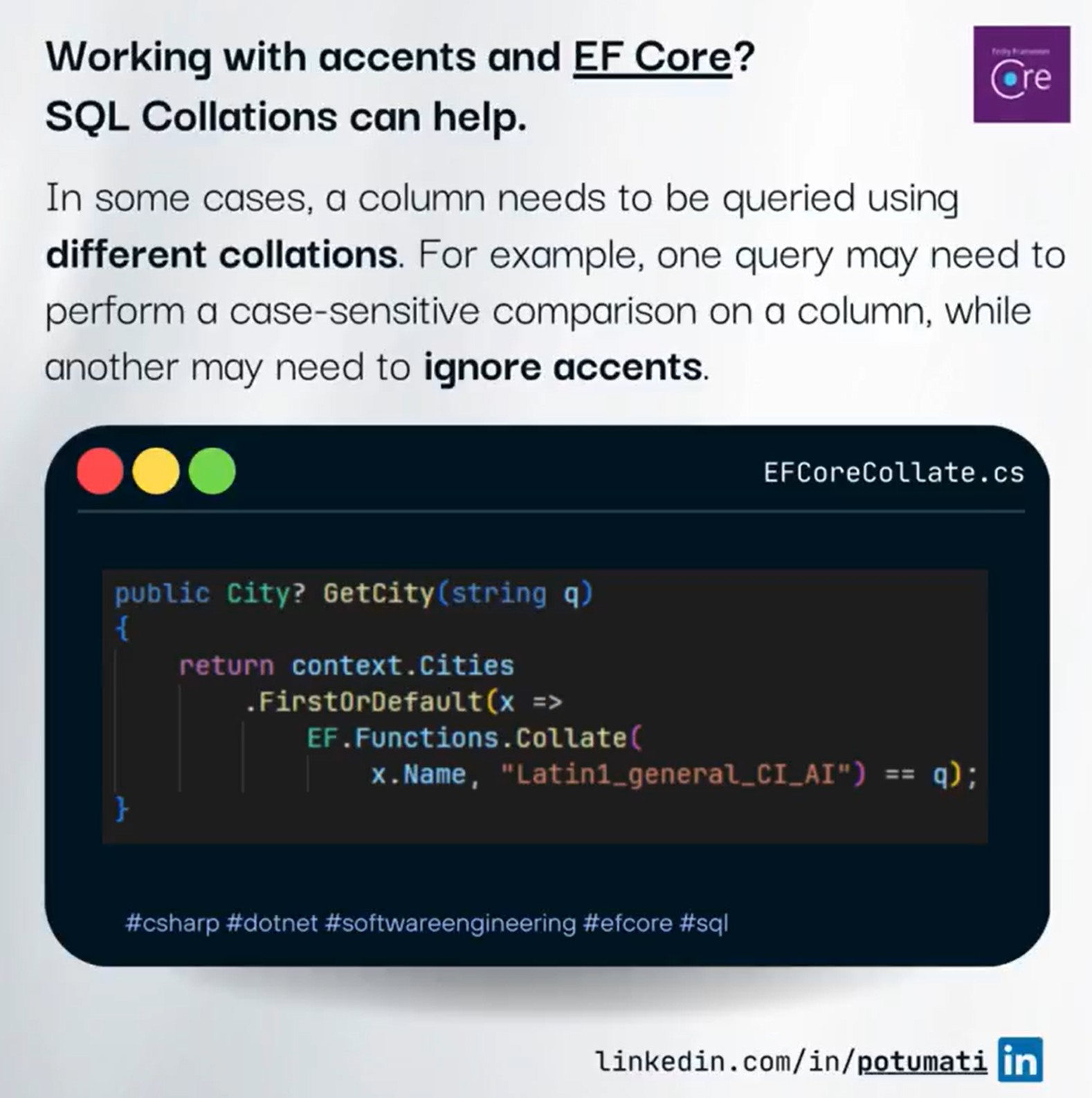
Code snippet demonstrating EF.Functions.Collate for accent-insensitive querying in EF Core

Handling Accents in SQL with EF Core

Have you ever needed to handle accents in SQL? If you are Latin, you have certainly done it many times. And how does it work in EF Core? It鈥檚 easy, you just have to use EF.Functions.Collate! Warning: Overriding case-sensitivity in a query via EF.Functions.Collate (or by calling string.ToLower) can have a very significant impact on your application鈥檚 performance. 馃敆 Know more 馃憠 Adapted from my original post on LinkedIn . ...
March 15, 2024 路 1 min 路 70 words 路 Eduardo Potumati
Code snippet demonstrating the differences between Round, Floor, and Ceiling in C#

Differences Between Round, Floor, and Ceiling in C#

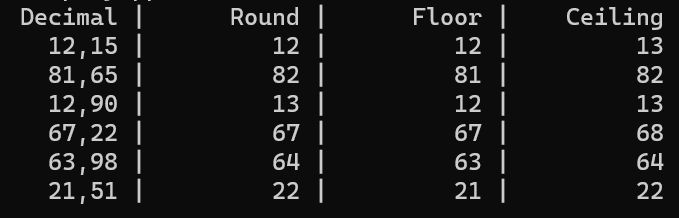
Do you know the differences between Round, Floor, and Ceiling in C#? Round: It follows standard mathematical rounding to the nearest integer. For example, 5.67 => 6, and 5.47 => 5. Floor: It rounds the number down to the nearest integer. For example, 5.67 => 5, and 5.47 => 5. Ceiling: It rounds the number up to the nearest integer. For example, 5.67 => 6, and 5.47 => 6. 馃憠 Adapted from my original post on LinkedIn . ...

February 15, 2024 路 1 min 路 78 words 路 Eduardo Potumati
Code diagram comparing struct and class memory allocation in .NET

Struct or Class: When to Use Which in C#

Struct or class? Most types in a framework should be classes, but there are some situations in which the characteristics of a value type make it more appropriate to use structs. Here are some things to consider: 馃憤 If your instances are small and short-lived, or commonly embedded in other objects, consider using a struct. 馃憥 However, be cautious when defining a struct. Only use it if the type represents a single value, is immutable, has an instance size under 16 bytes, and will not need to be boxed frequently. ...

December 15, 2023 路 1 min 路 125 words 路 Eduardo Potumati